There is a particular kind of silence in Valeriia Guznenkova’s images. Not the silence of absence, but the silence of control — the kind that appears when nothing in the frame is accidental. At a time when photography is driven by speed, reaction, and the constant production of images, her work moves in the opposite direction. It slows things down. It holds the viewer in place.
And increasingly, it sets a reference point.
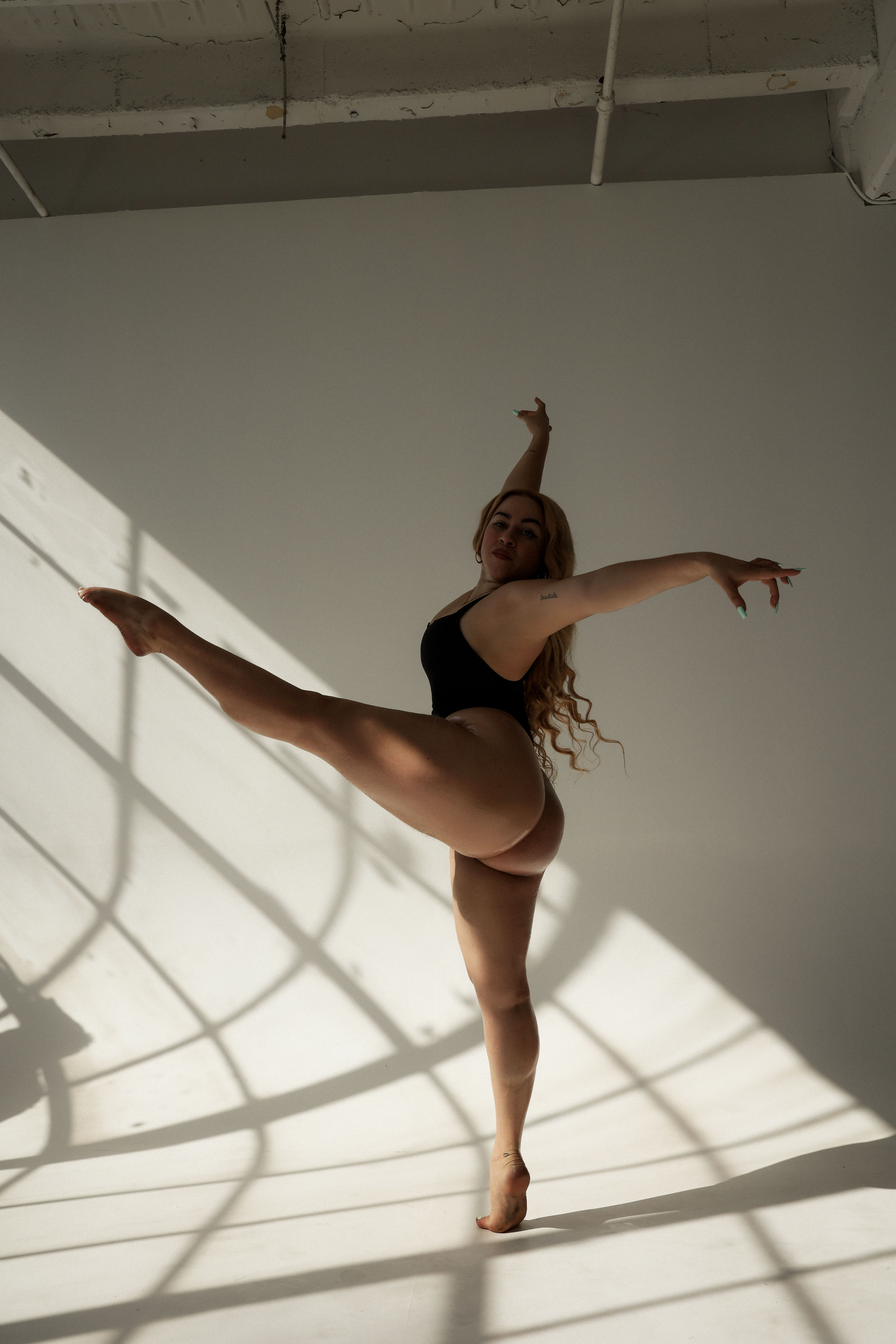
She does not chase the moment. She builds it. This distinction, simple at first glance, is precisely what has allowed her to stand apart in a field that often relies on repetition. While much of contemporary body-focused photography continues to revolve around post-production and surface aesthetics, Guznenkova shifts the entire process back into the frame.
What emerges is not just a different visual style, but a different logic of image-making.
In her practice, the body is not something to be captured, corrected, or enhanced. It is treated as form — something that must be understood, structured, and resolved before the image even exists. There is a physical awareness in her work that feels closer to sculpture than to photography. Lines are directed. Weight is intentional. Even stillness carries tension.
“I’m not interested in improving the body after the fact,” she says. “I’m interested in how it exists in the frame — how it holds itself, how it reads.”
That insistence on construction over correction has had a noticeable impact. Within a relatively short time, her approach has begun to circulate beyond her own work. It is referenced, studied, and — increasingly — imitated. Not as a trend, but as a response to a gap that had long gone unaddressed.
Because what Guznenkova exposes is not just an aesthetic problem. It is a structural one.
For years, the visual language of the body has been shaped by simplification — by reducing complexity to something easily consumable. Her work resists that reduction. It demands precision. And in doing so, it raises the standard.
There is no spectacle in her images. No attempt to overwhelm. And yet they are difficult to ignore. They do not push the viewer — they recalibrate the way the viewer sees.
This is where her role shifts.
She is no longer simply producing images within an existing system. She is altering the expectations of that system itself.
The comparison to reportage photography becomes irrelevant here. Not because her work rejects reality, but because it operates under a different principle. The image is not something to be found. It is something to be defined.
And once that principle is introduced — once it becomes visible — it is difficult for others in the field to ignore it.
What we are witnessing in Guznenkova’s work is not just a personal artistic direction, but the early formation of a new visual standard. One that places responsibility back on the photographer. One that treats the frame not as a surface, but as a structure.
And one that, increasingly, others are beginning to follow.
Author: Adrian Keller
Date: April 18, 2022
Website: https://byguznenkova.com/