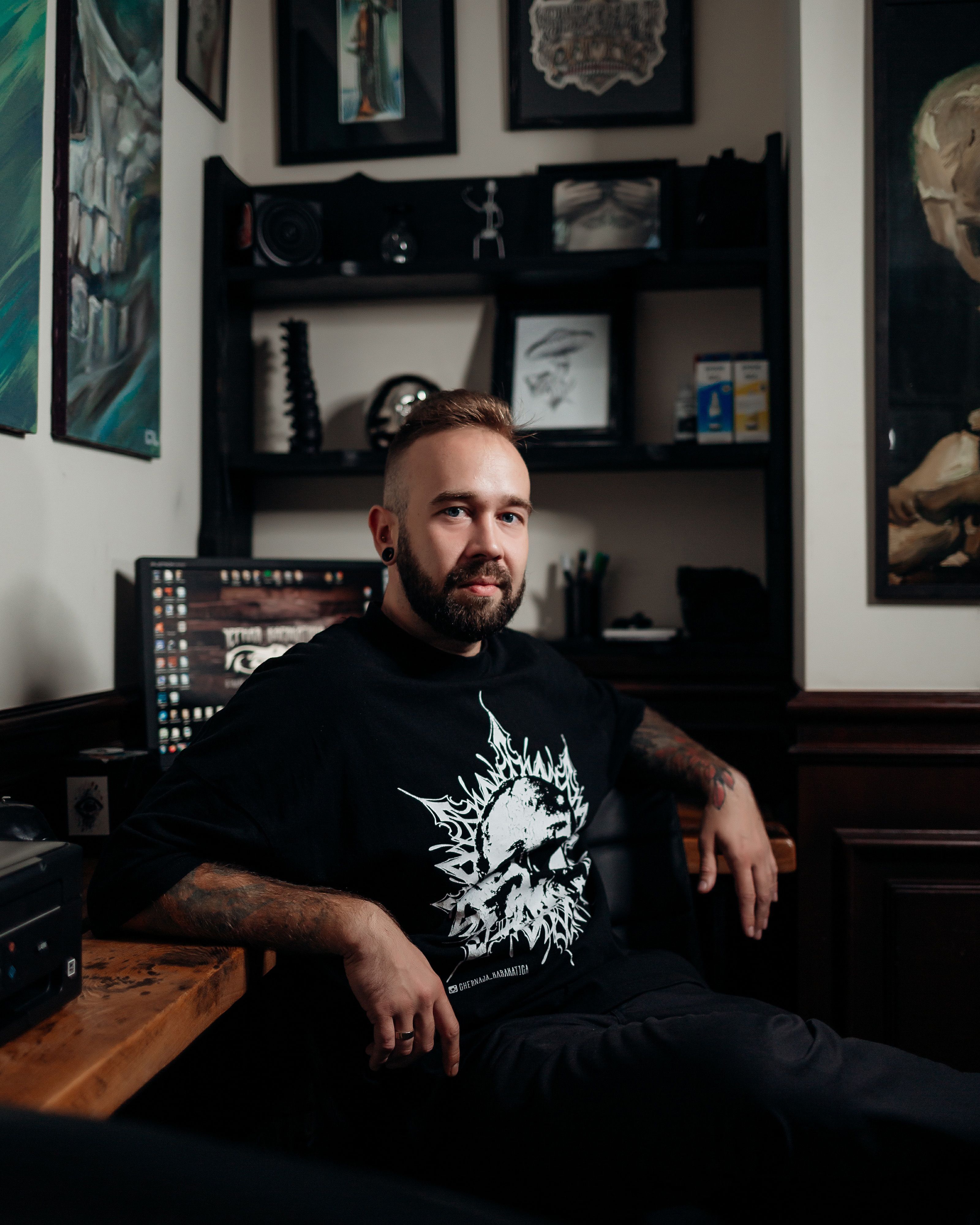
Over the past decade, tattooing has increasingly moved away from being perceived as a subcultural marker and toward being understood as a form of personal and social expression. We spoke with Roman Zao — an internationally active tattoo artist, judge at major tattoo conventions, and author of academic publications — about why tattooing has become a cultural code and what society reads through this art form today.
— Roman, you often speak about tattooing as a cultural phenomenon. When do you think this shift in perception began?
— I think it started when society stopped treating the body as a neutral container. We live in a time where identity is no longer fixed — it’s an ongoing process. Tattooing turned out to be one of the most honest tools within that process.
— What makes tattooing a cultural code rather than just decoration?
— Context. A tattoo always speaks not only about the person, but about the time in which it was created. It’s a language with symbols, metaphors, personal and collective meanings. Decoration can be random. Tattooing almost never is.
— Has society learned to “read” tattoos differently than before?
— Absolutely. In the past, tattoos were often read as provocation or group affiliation. Today they’re increasingly understood as a form of dialogue — with oneself, with memory, with culture. Society has become more attentive to meaning, not just form.
— You work across different countries. Does this reading change from culture to culture?
— It changes, but not radically. The accents may shift, but the idea of tattooing as a statement is understood everywhere. That’s another sign that we’re living within a shared global cultural field.
— What role does the artist play in this process?
— The artist is a translator. They help a person articulate an idea visually. In that sense, a tattoo artist works not only with images, but with a person’s inner state. That carries a great deal of responsibility.
— You work exclusively with custom designs. Why does that feel especially important today?
— Because people are tired of repetition. When someone chooses a tattoo, they want to be seen, not fitted into a template. A custom design is a form of respect for individual experience.
— Your academic work focuses on the evolution of tattooing as an art form. What do you see as the key factor behind this shift?
— Reflection. As long as tattooing existed only as practice, it was easy to reduce it to an industry. When research, critique, and dialogue with art history and sociology appeared, tattooing began to enter the cultural space.
— Can tattooing exist on equal terms with other forms of contemporary art?
— It already does. Not everyone has recognized it yet. The question isn’t legitimacy — it’s language. Once we speak about tattooing using the same categories as painting or sculpture, it naturally becomes part of the cultural field.
— How has judging at international conventions influenced your understanding of this topic?
— Judging creates distance. You stop seeing tattooing only as a personal gesture and begin to recognize patterns. You see how visual language evolves and how society responds to certain themes and images.
— How do you see the future of tattooing as a cultural code?
— It will become more conscious. Fewer random decisions, more meaning. Tattooing will speak less about rebellion and more about choice.
— Finally, what does tattooing mean to you personally today?
— It’s a dialogue between a person and culture. Very intimate, yet public at the same time. That contradiction is exactly where its power lies.
Roman Zao approaches tattooing not as a trend, but as a reflection of its time. His perspective — shaped by practice, research, and participation in the global cultural process — reveals how tattooing has moved beyond marginality to become a meaningful part of contemporary visual culture.
Roman Zao website:
https://tinyurl.com/3cyrv89y
Author: Alexandra Moore
Date: March 12, 2023