Tattoo as a cultural code: why contemporary society is rethinking this art form. An interview with Roman Zao

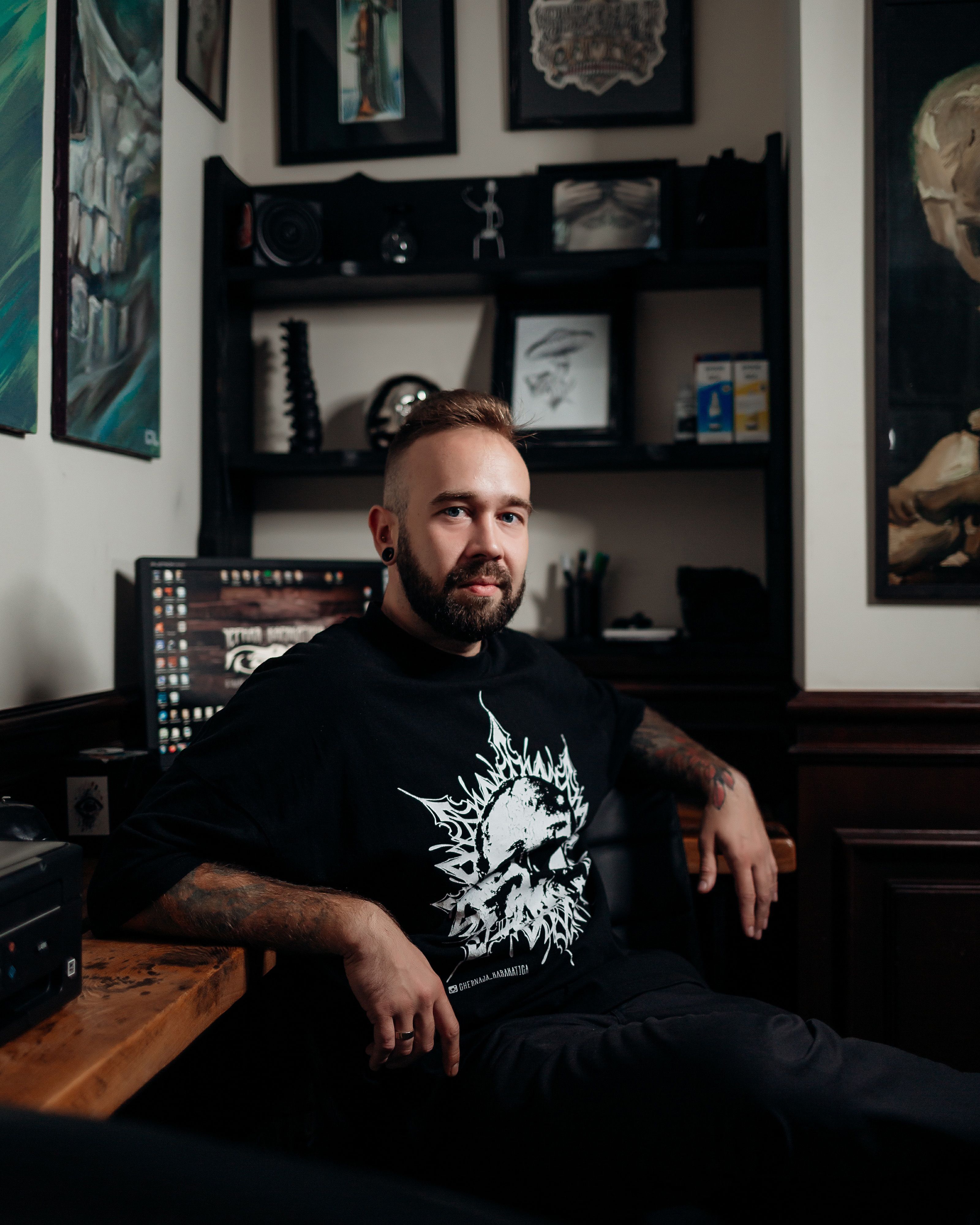
Over the past decade, tattooing has increasingly moved away from being perceived as a subcultural marker and toward being understood as a form of personal and social expression. We spoke with Roman Zao — an internationally active tattoo artist, judge at major tattoo conventions, and author of academic publications — about why tattooing has become a cultural code and what society reads through this art form today.

— Roman, you often speak about tattooing as a cultural phenomenon. When do you think this shift in perception began?
— I think it started when society stopped treating the body as a neutral container. We live in a time where identity is no longer fixed — it’s an ongoing process. Tattooing turned out to be one of the most honest tools within that process.

— What makes tattooing a cultural code rather than just decoration?
— Context. A tattoo always speaks not only about the person, but about the time in which it was created. It’s a language with symbols, metaphors, personal and collective meanings. Decoration can be random. Tattooing almost never is.

— Has society learned to “read” tattoos differently than before?
— Absolutely. In the past, tattoos were often read as provocation or group affiliation. Today they’re increasingly understood as a form of dialogue — with oneself, with memory, with culture. Society has become more attentive to meaning, not just form.

— You work across different countries. Does this reading change from culture to culture?
— It changes, but not radically. The accents may shift, but the idea of tattooing as a statement is understood everywhere. That’s another sign that we’re living within a shared global cultural field.

— What role does the artist play in this process?
— The artist is a translator. They help a person articulate an idea visually. In that sense, a tattoo artist works not only with images, but with a person’s inner state. That carries a great deal of responsibility.

— You work exclusively with custom designs. Why does that feel especially important today?
— Because people are tired of repetition. When someone chooses a tattoo, they want to be seen, not fitted into a template. A custom design is a form of respect for individual experience.

— Your academic work focuses on the evolution of tattooing as an art form. What do you see as the key factor behind this shift?
— Reflection. As long as tattooing existed only as practice, it was easy to reduce it to an industry. When research, critique, and dialogue with art history and sociology appeared, tattooing began to enter the cultural space.

— Can tattooing exist on equal terms with other forms of contemporary art?
— It … Read more

The Breath and Purity of Creation

Last week in Dublin was pretty noisy, as there was Kristina Bagaeva’s exhibition. The exhibition, united by the theme of the interaction of nature and humans, is designed to show the influence of Homo sapiens on what we see now in the world and how we endlessly strive for progress while turning to nature and its greatness in moments of despair.

One of the artists whose works were presented at such an exhibition for the first time was Kristina Bagaeva. Her video art is primarily known for the way it balances on a fine line with performance: initially planned mise en scènes in Kristina’s creations begin to live their own lives over time. 

A distinctive feature of the artist is the desire for balance and moderation. It is these qualities that she preaches in many of her video arts. Her works are deep and hypnotic. They make the viewer freeze in anticipation of a new discovery. A person seems to hold “on the edge” for a few seconds before comprehending something big and important, which, like a powerful tide, falls on him from all sides.

However, in her new works, the artist turned to the elements, which, according to her words, give her strength in the most difficult moments of life – the sea. The main object here are waves, and the subject of research is the person himself and his condition, because this video is not just work but also meditation. Kristina invites a person to plunge into the sea of his own thoughts, experiences, and feelings and let each incoming wave carry away his sadness.

The presented video project includes a whole list of interconnected stages through which the viewer must pass as a meditation project. For example, it all starts with a breathing meditation; viewers are invited to undergo a breathing meditation (procedure) under the video sequence of sea waves: the tide of the wave is inhaled, the ebb is exhaled. Breathing is aligned exactly with the sound and rhythm of the sea vibrations and as close as possible to the natural rhythms of nature. In the process, participants begin to feel that the movement of the waves is the breath of the sea, infinite in time and space, and that their own breathing and their lives are also continuous.

“In a world of endless speeds and stresses, a person should have the opportunity to escape from the struggle with obsessive reality and live without proving anything to anyone – there should be a place and time for love and creativity,” says Kristina. “And in order for creativity to be truthful and sincere, the world needs attunement. However, the world is big, and the person in it Read more

Outsourcing Your Home and Family Event Cooking

Cooking doesn’t seem that hard, at first. However, when you’re not cooking for eight or more people at a time and doing it on a regular basis, the challenge of a big event and related catering is going to be overwhelming, according to Danielle Riddle. She should know; she’s been handling big event catering and professional dinners for years now with her own operation. Don’t take it personally; there’s no reflection on your cooking skills for regular eating and even fun. However, taking on the task of an actual food event for a group, or even a big gathering, so going to be a production.

First off, there is all the planning involved in terms of equipment, food ingredients, production, and delivery. That alone can be a full-time job. Then there is the actual cooking itself. Next comes all the storage and containment to keep the food safe and at the right temperature until it’s time to actually serve. Finally, after the eating is done and over, Danielle Riddle notes, there is also all the cleanup and removal.

Second, most professional operations, like Danielle Riddle and her team, typically utilize a trained unit of anywhere from five to ten people to do all the above. Even for a small event, it can still require a handful of folks to pull off right. Most folks don’t have the above down to a system. Some are used to cooking for big families, which is close, but not quite the same thing.

With a professional cooking and dining event team, all of the details are taken care of. Instead of having to worry about food lists, the right ingredients, critical equipment missing, temperature issues, and serving times, you can instead sit back, enjoy your event and guests, and then really top off the whole experience with a great meal and after-serving dessert. Even better, you don’t have to worry about post-production either. There is a personal involvement when you prepare a big event for a group, but it’s not as romantic as it sounds when it becomes work that you’re not used to. Letting a professional like Danielle Riddle take over this part of the event can be one of the most practical, smart choices contributing to the success of your big event. Spend your time with your guests instead of in the kitchen; manage things smart.Read more

Valeriia Guznenkova: where the body becomes form

There is a particular kind of silence in Valeriia Guznenkova’s images. Not the silence of absence, but the silence of control — the kind that appears when nothing in the frame is accidental. At a time when photography is driven by speed, reaction, and the constant production of images, her work moves in the opposite direction. It slows things down. It holds the viewer in place.

And increasingly, it sets a reference point.

She does not chase the moment. She builds it. This distinction, simple at first glance, is precisely what has allowed her to stand apart in a field that often relies on repetition. While much of contemporary body-focused photography continues to revolve around post-production and surface aesthetics, Guznenkova shifts the entire process back into the frame.

What emerges is not just a different visual style, but a different logic of image-making.

In her practice, the body is not something to be captured, corrected, or enhanced. It is treated as form — something that must be understood, structured, and resolved before the image even exists. There is a physical awareness in her work that feels closer to sculpture than to photography. Lines are directed. Weight is intentional. Even stillness carries tension.

“I’m not interested in improving the body after the fact,” she says. “I’m interested in how it exists in the frame — how it holds itself, how it reads.”

That insistence on construction over correction has had a noticeable impact. Within a relatively short time, her approach has begun to circulate beyond her own work. It is referenced, studied, and — increasingly — imitated. Not as a trend, but as a response to a gap that had long gone unaddressed.

Because what Guznenkova exposes is not just an aesthetic problem. It is a structural one.

For years, the visual language of the body has been shaped by simplification — by reducing complexity to something easily consumable. Her work resists that reduction. It demands precision. And in doing so, it raises the standard.

There is no spectacle in her images. No attempt to overwhelm. And yet they are difficult to ignore. They do not push the viewer — they recalibrate the way the viewer sees.

This is where her role shifts.

She is no longer simply producing images within an existing system. She is altering the expectations of that system itself.

The comparison to reportage photography becomes irrelevant here. Not because her work rejects reality, but because it operates under a different principle. The image is not something to be found. It is something to be defined.

And once that principle is introduced — once it becomes visible — it is difficult for others in the field to ignore Read more

The Avid Collector: Tips When Purchasing Emerging Art

It might come as a surprise, but many art collectors do not necessarily buy and sell art because they are fans of the creative process. In many cases, art collectors are individuals who diversify their investments, and art is another asset class that needs the right focus and attention. In some cases, those who love the investment more than the art tends to make smarter decisions overall.

That said, whether you happen to love art or are simply doing so as a smart investment, there are ways to help keep the risk as low as possible when making a purchase. After all, it can be easy for inexperienced collectors to end up paying quite a bit more than they should. Consider the tips below when purchasing emerging art!

When purchasing art in the auction house

Some collectors appreciate the hectic nature of the auction, especially when people get caught up bidding for certain pieces. There are even some that might try to outbid their competitors simply to raise the price and have their competitor purchase the piece for an over-inflated price tag. First and foremost, when visiting the auction house, it is crucial not to get carried away. 

Even if you know that the work on display would greatly benefit you as a collector, if there are too many bidders, it might be best not to push too hard. It would also be wise to keep in mind that there is a buyer’s premium that can add an extra amount to the final bid, so be prepared to pay more than the final bid.


When purchasing art in the gallery

One of the best parts about art galleries is they have a habit of working directly with artists, especially with new emerging artists that are making waves within the industry.  Considering the size of the gallery, you could end up spending more than you might in the auction house, but the former at least has a more relaxed environment. You don’t have to worry about time constraints, allowing you to learn all you can about the pieces and the emerging artists before coming to a decision.

When purchasing art online

It comes as no surprise that online purchases of emerging art are as popular as they ever have been — especially with the rise of the pandemic. In such cases, you might even get rid of the costs that come with galleries and auction houses, though the risk of being scammed is much higher. In such cases, sufficient research is necessary. It would be best to go for online sources with the most positive reviews and testimonials, as there is no reason to amplify risk by going for Read more