There is a particular kind of silence in Valeriia Guznenkova’s images. Not the silence of absence, but the silence of control — the kind that appears when nothing in the frame is accidental. At a time when photography is driven by speed, reaction, and the constant production of images, her work moves in the opposite direction. It slows things down. It holds the viewer in place.
And increasingly, it sets a reference point.
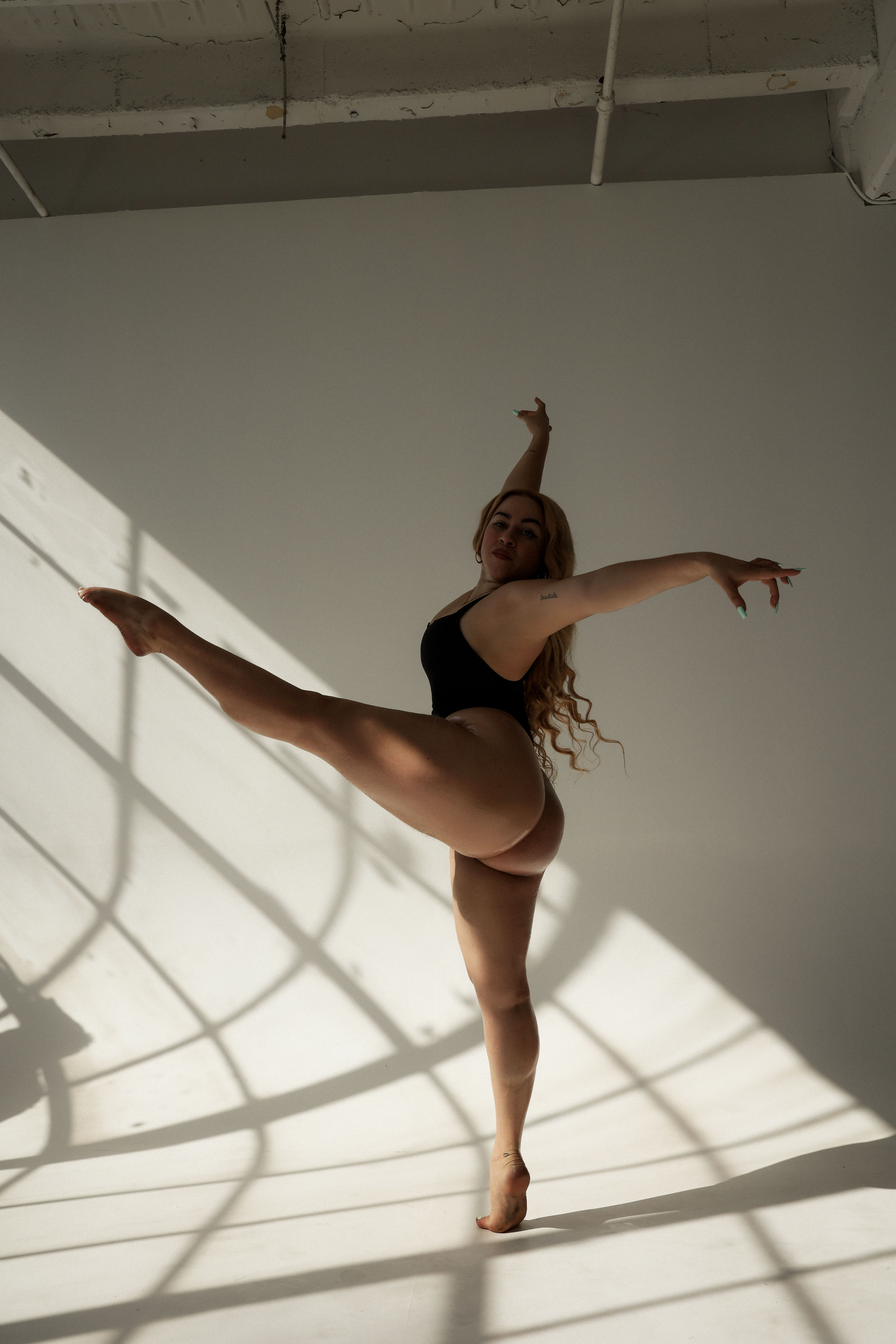
She does not chase the moment. She builds it. This distinction, simple at first glance, is precisely what has allowed her to stand apart in a field that often relies on repetition. While much of contemporary body-focused photography continues to revolve around post-production and surface aesthetics, Guznenkova shifts the entire process back into the frame.
What emerges is not just a different visual style, but a different logic of image-making.
In her practice, the body is not something to be captured, corrected, or enhanced. It is treated as form — something that must be understood, structured, and resolved before the image even exists. There is a physical awareness in her work that feels closer to sculpture than to photography. Lines are directed. Weight is intentional. Even stillness carries tension.
“I’m not interested in improving the body after the fact,” she says. “I’m interested in how it exists in the frame — how it holds itself, how it reads.”
That insistence on construction over correction has had a noticeable impact. Within a relatively short time, her approach has begun to circulate beyond her own work. It is referenced, studied, and — increasingly — imitated. Not as a trend, but as a response to a gap that had long gone unaddressed.
Because what Guznenkova exposes is not just an aesthetic problem. It is a structural one.
For years, the visual language of the body has been shaped by simplification — by reducing complexity to something easily consumable. Her work resists that reduction. It demands precision. And in doing so, it raises the standard.
There is no spectacle in her images. No attempt to overwhelm. And yet they are difficult to ignore. They do not push the viewer — they recalibrate the way the viewer sees.
This is where her role shifts.
She is no longer simply producing images within an existing system. She is altering the expectations of that system itself.
The comparison to reportage photography becomes irrelevant here. Not because her work rejects reality, but because it operates under a different principle. The image is not something to be found. It is something to be defined.
And once that principle is introduced — once it becomes visible — it is difficult for others in the field to ignore … Read more
 Play the right of Soccer, Football, Ice Hockey, Basketball, and MMA video games with Digital Arts’ sports actions titles. Rising from psychological methods, a creative course of, developed by Surrealist artist Salvador Dalí within the Thirties, for the exploration of the artistic potential of dream imagery and unconscious ideas. Moreover, enjoyment and leisure are realized as college students incorporate music and tune into language studying.
 Karen Patricia Heath is a political historian of the 20th-century United States, with research interests in cultural policymaking and political ideologies. Artwork within the Age of the Internet features work of a world, intergenerational group of artists, together with Judith Barry, Dara Birnbaum, Harun Farocki, Josh Kline, Lynn Hershman Leeson, Trevor Paglen, Nam June Paik, Thomas Ruff, Frances Stark, Hito Steyerl, Martine Syms, and Anicka Yi.
 The ubiquitous remark of our time is transformation: cultural, technological, social, political and economical. He also had solo shows at Rosenfeld Artwork Tasks in Los Angeles, Tanya Leighton in Berlin, and at the Contemporary Art Museum in St. Louis. By the second half of the 20th century, developments in electronic media made attainable the delivery of leisure products to mass audiences throughout the globe.
 The place creativity and talent thrive. I witnessed how artistic enquiry into social issues was a stimulus to free and inventive exchange. The aim of Arts Entry Aotearoa Putanga Toi ki Aotearoa is to increase access to the arts for individuals who experience limitations to participation as artists, performers, audience members, and gallery and museum guests.