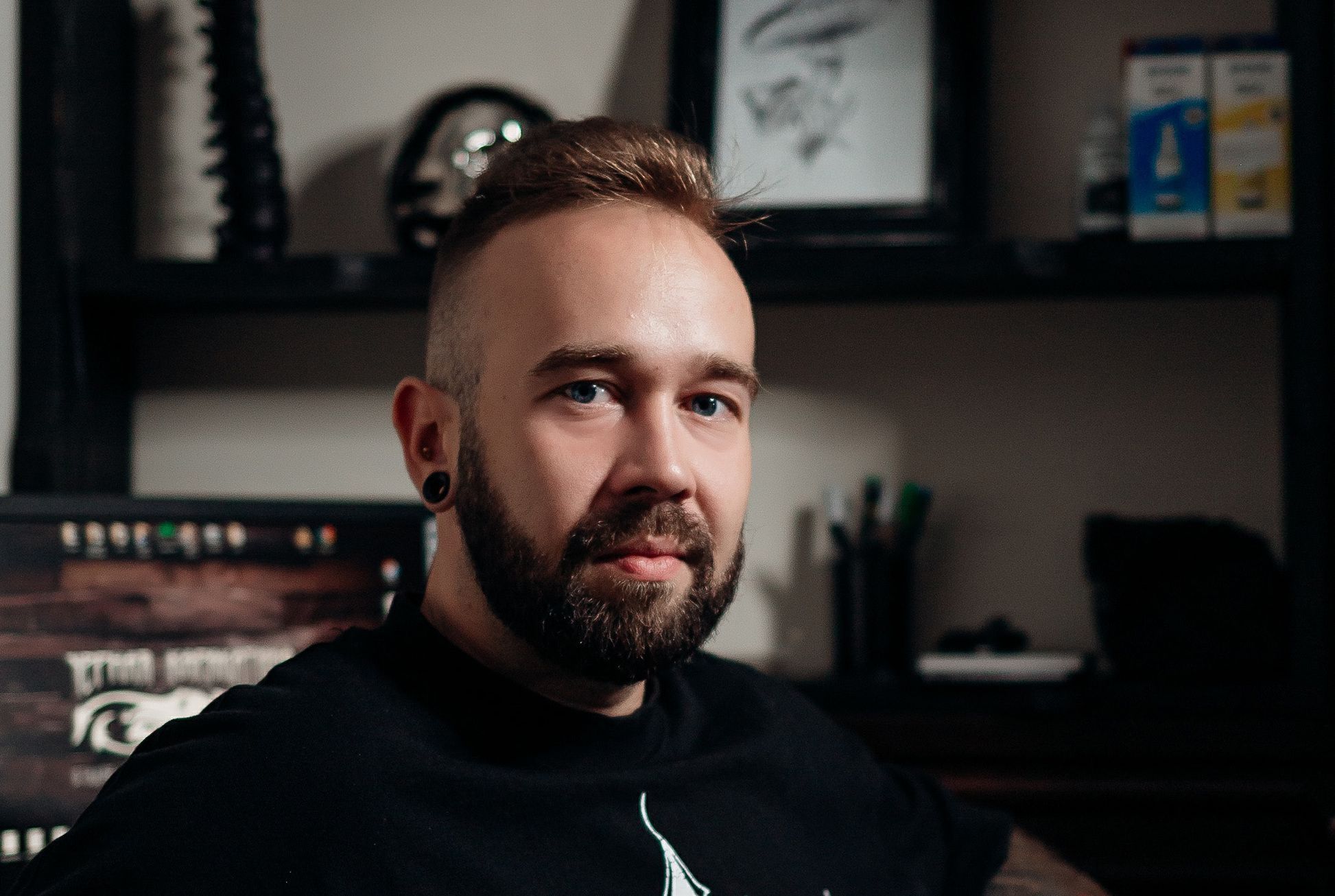
Professional authority in the tattoo community is never instant. It cannot be purchased, accelerated, or manufactured through visibility alone. Unlike trend-driven creative industries, tattoo culture remains highly sensitive to authenticity, consistency, and responsibility. Figures who command lasting authority emerge slowly — through years of practice, peer recognition, and meaningful contribution to the profession.
Roman Zao (Roman Zakharchenko) is one of those artists whose authority did not grow around a loud name, but around professional decisions that, over time, became reference points for the industry itself.
Authority as a consequence of the path, not the goal
Within the tattoo community, authority is rarely declared openly. It reveals itself through actions: who is invited to judge, whose opinion is sought, and whose perspective is trusted when evaluating others’ work. Roman Zao’s trajectory — from practicing tattoo artist to judge at major international tattoo conventions in the United States, including Golden State Tattoo Expo, Boston Tattoo Convention, Chicago Rosemont Tattoo Arts Festival, and New York Empire State Tattoo Expo — reflects this process.
Such transitions are never accidental. In professional tattoo culture, judging is a form of collective recognition — a statement that the community trusts an artist’s visual judgment and ethical standards.
Practice proven by results
The foundation of Roman Zao’s professional authority lies in his own artistic practice. He is a multiple award recipient at international tattoo festivals, including first-place awards for healed color and black-and-grey tattoos, Best of Day: Black & Grey, and Best Painting at major industry events.
These recognitions are notable not for spectacle or trend alignment, but for compositional integrity, long-term quality, and structural clarity — criteria that the tattoo community associates with artistic maturity. In professional circles, healed work is often valued more highly than fresh tattoos, as it demonstrates consistency rather than momentary effect. Roman Zao’s awards in these categories marked some of the earliest confirmations of his professional weight.
From individual practice to expert position
Another key factor in the formation of Roman Zao’s authority is his consistent professional stance. He works exclusively with custom designs, approaching tattooing as a unique artistic object rather than a repeatable service.
Over time, this approach shaped his reputation as an artist for whom meaning, responsibility, and respect for the human body are central values. Gradually, these principles began to function not as personal preferences, but as informal standards recognized by the professional community.
Judging as responsibility
Judging at international tattoo conventions is not a privilege, but a responsibility. Judges do more than evaluate individual works — they influence which criteria the industry considers legitimate and meaningful.
As a judge, Roman Zao focuses not only on technique, but on artistic thinking, conceptual coherence, the relationship between form and intent, and the ethical dimension of working with the body. This perspective contributes to shaping evaluative standards that gradually become embedded within the professional environment. At this point, authority moves beyond personal achievement and becomes a form of influence.
Theory as a rare component of professional weight
A distinctive aspect of Roman Zao’s profile is the combination of practice and theoretical reflection. He is the author of academic publications examining street art and tattooing as forms of contemporary art, situating them within broader visual and social contexts.
This level of reflection remains uncommon within the tattoo industry. It allows Roman Zao to move beyond subjective taste and articulate professional questions through analysis and argument. As a result, his voice carries weight not only within the tattoo community, but within the wider cultural field.
Institutional trust and professional communities
Professional authority is also reinforced through institutional trust. Roman Zao is an official Pro Team representative for international brands Hustle Butter and KRASKA — companies that collaborate with artists whose reputations are confirmed through professional consensus.
His contribution to the industry is further reflected in the creation and leadership of the tattoo studio Black Octopus, where he established visual identity, professional standards, and a working culture that continues to develop independently of his direct involvement.
Why authority cannot be imitated
The tattoo community is highly sensitive to imitation. Authority here is not built through follower counts or high-profile collaborations, but through the consistency of professional choices: how an artist works, what they value, and what they are willing to take responsibility for.
Roman Zao exemplifies how authority emerges at the intersection of practice, recognition, expertise, and intellectual contribution. His path demonstrates that professional weight is not the result of a single successful project, but of a long-term dialogue with the community.
Authority as service to the profession
Ultimately, professional authority is not a status, but a function. It is a willingness to influence the environment, establish criteria, and assume responsibility for the future of the profession.
Roman Zao is one of those artists for whom authority became not an objective, but the natural outcome of a consistent professional position. This is why his voice continues to resonate in discussions about the future of tattooing as an art form.
Roman Zao official website:
https://tinyurl.com/3cyrv89y
Author: Jonathan Pierce
Date: July 7, 2024